Search Site
Ask LENRBot
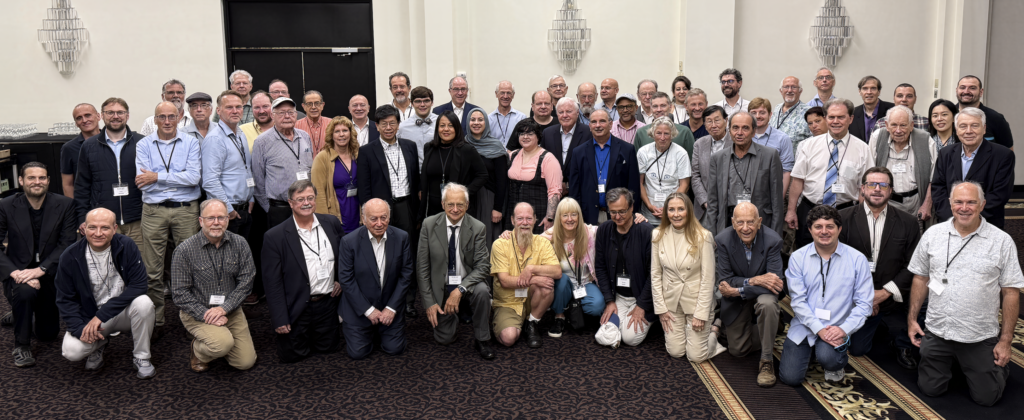
Our SSF team was on-site all week for the 27th International Conference on Condensed Matter Nuclear Science, ICCF-27, held August 31 through September 4, 2026, in Niagara Falls, Canada. Four days, dozens of talks, and a reminder of just how wide this field has become: electrochemistry, plasma physics, astrophysics, nuclear engineering, and even biology all showed up on the same agenda.
Below are our highlights from the floor, the talks that stood out most to our team, not a record of the full program. The conference ran well over a dozen sessions across five days, and you can find the complete schedule, every talk title, and every author on the official ICCF-27 program page.
The conference opened with David Nagel laying out the big picture, the when, where, why, and how of LENR, which past experiments deserve closer replication, and an update from his own team’s current work at George Washington University. His framing was blunt: a real breakthrough here wouldn’t just be a scientific footnote, it would reshape nuclear physics, carry enormous global impact, and, he noted, could be lucrative for whoever gets there first.
From there, the program moved into results from several long-running experimental programs:
The day closed with a panel moderated by Dimiter Alexandrov, bringing together Carl Page, David Nagel, Frank Gordon, Jean-Paul Biberian, F. Petrucci, Francesco Celani, Yasuhiro Iwamura, Shinya Narita, and Jirohta Kasagi for a wide-ranging discussion on the practical realities of researching, financing, and eventually deploying novel LENR energy sources.
Day two kicked off with a second talk from David Nagel, this time on bio-transmutation LENR experiments developed with student researchers Amogha Gummadivalli and Ayan Marin from Chantilly High School, an effort aimed at designing a simple, precise, and widely repeatable standard biotransmutation experiment.
Other highlights:
Vladimir Vysotskii opened day three with a pair of talks: one on the physical basis and possible mechanisms for LENR reactions in water with hydrogen gas production, and a second examining the electrodynamic mechanism behind direct energy transfer from faster daughter LENR fusion isotopes to electric current in the E-Cat system.
Theresa Benyo introduced Astral Systems’ Multi-State Fusion project, which combines inertial electrostatic confinement (IEC) fusion with lattice confinement fusion to boost fusion event rates, alongside work on optimizing cathode design to further increase neutron yields.
Matt DeCapua presented the MIT LENR team’s perspective on experimental design going forward, his core argument was that well-characterized inputs and outputs, down to composition, structure, and dynamics, are what let both anomalies and null results actually inform future work. That means detailed reporting: waveforms, full-sample scans, and other unambiguous diagnostics, not just headline numbers.
Ruby Carat previewed her next documentary, “Anomalous Behavior,” built on decades of interviews with researchers in the field.
It was also a big day for our own team: Lily and Eman took the stage to present the documentary our team produced on Dr. Melvin Miles, and to introduce the Solid-State Fusion team to the wider ICCF community.
The final stretch of the conference opened with Andreas Otte’s talk, “Re-evaluating Nuclear Binding Energy and Mass Defect: A Proton-Electron Composite Model Approach,” followed by Francesco Celani reporting progress on boosting anomalous heat effects using modified constantan wires in a dual-electrode setup paired with silicon carbide-based electronics. Nathaniel Hanks offered one of the week’s more unusual theoretical talks, on geometry-locked mesoscale environments for condensed matter nuclear science, derived Beltrami beat laws, and a modular kernel-mapping interface.
On the experimental side, Kang Zhou presented his group’s work co-depositing nickel and hydrogen onto copper tubes, reporting spontaneous voltage, high-energy charged particles, and excess heat that they suggest may indicate a nuclear reaction inside the reactor. A separate talk detailed the calibration of three different neutron detector types, CR-39 solid-state, He-3 proportional tubes, and scintillation detectors, in preparation for testing for nuclear processes when titanium sheets are exposed to lasers.
Thomas Grimshaw gave an update on the LENR Research Documentation Initiative with ISCMNS, covering the project’s history, the people behind it, and next steps toward institutionalizing both electronic and hardcopy archives for the long term. Marc Fleury spoke to the broader challenge the field still faces in gaining mainstream scientific acceptance, arguing the path forward runs through open science paired with detection networks robust enough that verification keeps pace with any proliferation of claims.
Closing out the conference, Michael Clarage presented on behalf of Aureon Energy, describing experiments using electromagnetic stimulation to achieve nuclear transmutation, work that grew out of astrophysical research simulating solar plasma and evolved toward radioactive waste remediation, with unexpectedly high energy production and reaction rates observed along the way. Bob Greenyer closed the technical program presenting Huang et al.’s work on an experimental process the group says generates energy from water while producing large amounts of a rare oxygen isotope, early data also hints the byproduct might disrupt cancer cell metabolism, though the team was careful to stress that independent verification is still pending. Greenyer also shared his own model proposing that anomalous energy systems across solid, liquid, and plasma states form self-feeding, superconducting, magnetically charged toroidal structures with a shared two-day decay window, and called on researchers to test the model by timing reactor cycling to that window to maximize yield.
Four days, a genuinely global cast of researchers, and results ranging from incremental replication work to some ideas that will need a lot more scrutiny before the field settles on what to make of them, which is exactly what a conference like this is for. Video recordings and official proceedings from ICCF-27 will be posted in the months ahead, and we’ll flag them here as they go live.
Explore more SSF coverage of past ICCF conferences, including ICCF-24, ICCF-25, and ICCF-26, in our Event Videos Playlist.
The U.S. Department of Energy has published its Fusion Science and Technology Roadmap, a national strategy aimed at accelerating the commercialization of fusion energy by the mid-2030s. Organized around a Build–Innovate–Grow framework, the Roadmap sets near-term (2–3 years), mid-term (3–5 years), and long-term (5–10 years) actions to close critical gaps in materials, fuel cycle, plasma-facing components, confinement, blankets, and plant engineering — the six Core Challenge Areas identified as standing between today's private-sector demonstration platforms and a viable Fusion Pilot Plant in the 2030s.
The document also outlines a planned AI-Fusion Digital Convergence Platform intended to accelerate design and modeling across the field, and maps its priorities to the 2020 FESAC Long-Range Plan and DOE's newly formed Office of Fusion.
As DOE Under Secretary for Science Darío Gil frames it, the Roadmap is meant to chart a clear path for federal support to the fusion industry, identifying the science and technology milestones needed to bring commercial fusion power to the grid.
Source & Credit: U.S. Department of Energy, Fusion Science and Technology Roadmap, published June 2026.
Summary prepared for informational purposes; full roadmap available via the U.S. Department of Energy.
In 2020, NASA’s Glenn Research Center demonstrated an innovative nuclear powered application for deep space exploration based on lattice confinement fusion (LCF).